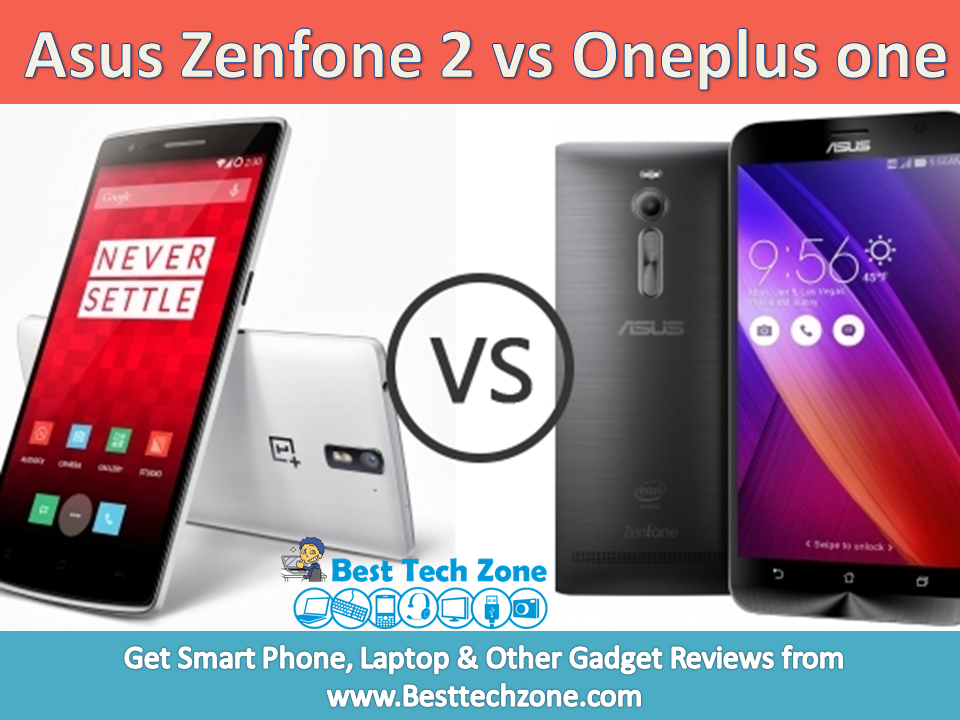
Asus Zenfone 2 vs Oneplus One

Asus Zenfone 2 and Oneplus One are the new flagships of different smartphone manufacturing companies. Both are having amazing features and specifications at their price range. Are you not able to choose which is the best to buy? Do you want to compare Asus Zenfone 2 vs Oneplus One?

Don’t worry friends, for the sake of you people here we are giving detailed comparison of Asus Zenfone 2 and Oneplus One. Let’s check out Asus Zenfone 2 vs Oneplus One Comparison  and find out which one is the best for you.

Asus Zenfone 2 vs Oneplus One

Design & display

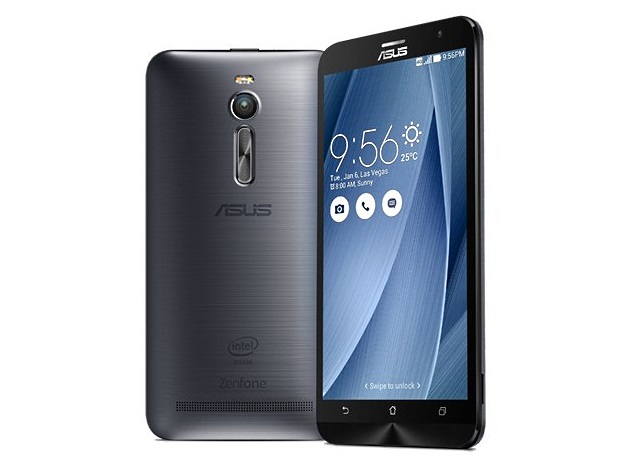
The Asus Zenfone 2 has a 5.5-inch full HD screen with IPS+ and Corning Gorilla Glass 3, which is the same as the OnePlus One. Where design goes, the Asus Zenfone 2 has brushed metal finish in the back, and curved case. The smartphone is 3.9 mm thick at the edges. Asus also says the Zenfone 2 has a “72% screen-to-body ratio that provides a maximised viewing experience”. Like LG, Asus has moved the volume-control key on the rear of the smartphone, but the power button is strangely on top. The Zenfone 2 will come in five colours Black, Gold, Gray, Red and White.

The OnePlus One also has a full HD 5.5-inch screen with LTPS IPS with Corning Gorilla Glass 3. The screen has TOL (Touch On Lens) technology, which removes the distance between the touch sensor and the display panel and thus allows the screen to respond instantly to a user’s touch. OnePlus One comes in two colours silk white and sandstone black.
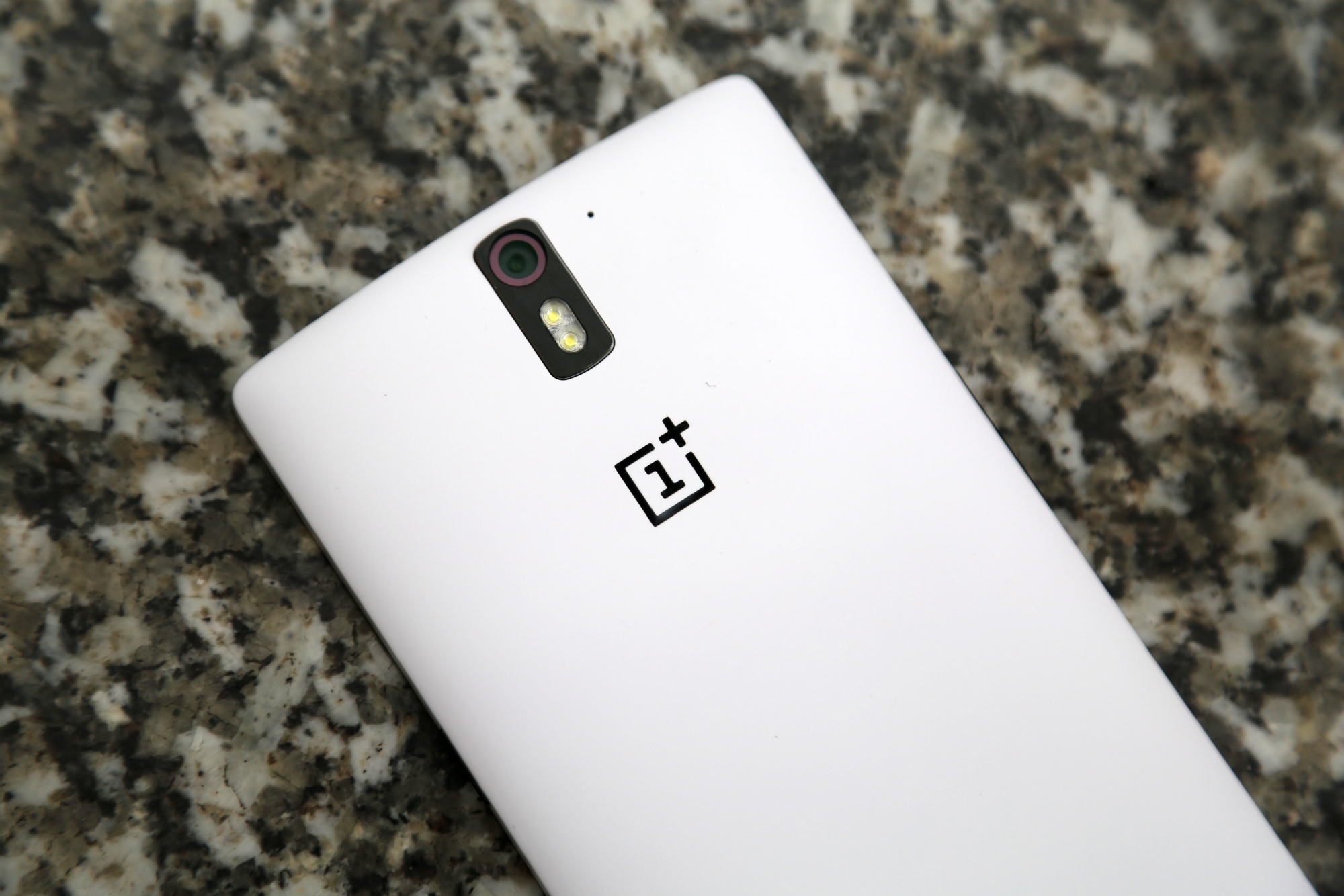
The 64GB black OnePlus One has a matte finish granite-like Moonstone rear panel which really makes the smartphone stand-out. In terms of design, the smartphone is 8.9 mm thick and weighs 162g and the power button is on the left, while the volume buttons are on the right, just below the SIM slot. It’s a more familiar design, which some users might prefer.

Processor, RAM, Storage:

The OnePlus One smartphone has Qualcomm Snapdragon 801 processor with 2.5GHz Quad-core and comes with 3GB RAM and 64GB internal storage and no external slot.

The Asus Zenfone 2 on the other hand has a 64-bit Intel Atom Z3580 processor clocked at 2.3GHz. It has 4GB RAM, which explains the considerable interest in the smartphone and like the OnePlus One, there is a 64 GB version of this smartphone as well.

Camera:

The OnePlus One has a 13MP rear camera and a 5 megapixel front camera. The rear camera supports 4K video recording with slow-motion. Where the camera’s performance goes, we had seen its pretty fast and there is a burst mode that lets you click up to 20 frames in one go. The results we got with the OnePlus were quite good with great details, even in macro shots.
With Asus Zenfone 2, the company has a given it a 13MP rear-facing and 5MP front-facing. Both have PixelMaster cameras which Asus claims offer enhancements like Low Light mode on both the rear and front cameras, 400% brighter photos and videos at night.

Asus says the Zenfone 2 has “blue glass infrared filter” which makes capture backlit scenes very easy and that there is zero-shutter lag on the camera. Asus has tweaked the camera to allow users to tinker with ISO settings, aperture, etc for those who want the DSLR-like experience.

Battery:

Asus Zenfone 2 has a 3000mAh battery and the company claims that this has a full day’s life on one single charge. The Zenfone 2 also comes with BoostMaster technology which enables twice as fast charging, letting users charge ZenFone 2 from from 0% to 60% in just 39 minutes, says the company.

In case of the OnePlus One, the battery is a 3100 mAh battery and in our review we saw that the smartphone easily lasted a whole day. So the Asus Zenfone 2 will have to life up to its claims of a full-day battery, if it plans to compete with OnePlus One.

OS and connectivity options:

Asus Zenfone 2 has an Android 5.0 Lollipop with ZenUI skin running on top of it. If you want the latest version of Android, Zenfone is the device to consider, although the ZenUI might not be something you want on Android Lollipop.

The OnePlus One runs Cyanogen 11S based on Android 4.4. OnePlus has released a hard to master update for its new Oxygen OS based on Android 5.0. With Oxygen OS, you get features like off-screen gestures, new to a pure Android phone. It gives you customisation likes the old OS, although installing the OS is a tedious process.

In terms of connectivity, the One Plus One supports 4G with nano and micro SIM trays in box, which is great. However it’s not a Dual-SIM phone. The OnePlus One supports Wi-Fi 802.11 b/g/n/ac, Bluetooth 4.0 and NFC as well as USB OTG that allows users to directly plug in a flash drive to your phone.

The Asus Zenfone 2 has a support for Bluetooth 4.0 with A2DP, Wi-Fi Direct, Wi-Fi hotspot (tethering) and NFC support. Unlike OnePlus One, Zenfone 2 is a dual-SIM smartphone with Dual SIM Dual Active (DSDA) technology which lets you take calls from a second SIM even if you are on the first SIM. Zenfone also supports USB OTG.

PRICE RS.19,999 Rs.21,998
OS Android OS,v5.0 (Lollipop) Android OS, v4.4.2 (KitKat), upgradable to v4.4.4 (KitKat)
CPU Quad-core 2.3 GHz Quad-core 2.5 GHz Krait 400
RAM 4 GB RAM 3 GB RAM
SCREEN 5.5 inches (~70.1% screen-to-body ratio) 5.5 inches (~71.9% screen-to-body ratio)
DISPLAY 1080 x 1920 pixels (~403 ppi pixel density) 1080 x 1920 pixels (~401 ppi pixel density)
SIM Dual SIM (Micro-SIM, dual stand-by, dual call) Single SIM (Micro-SIM)
CAMERA Rear Camera: 13 MP, Front Camera: 5 MP, LED Flash: Yes Rear Camera: 13 MP, Front Camera: 5 MP, LED Flash: Yes
MEMORY Internal Storage 32 GB, microSD Expandable Upto 64 GB Internal Storage 64 GB
BATTERY Non-removable Li-Po 3000 mAh battery Non-removable Li-Po 3100 mAh battery
OTHERS 4G,3G, Bluetooth, WiFi, GPS 4G, 3G, Bluetooth, WiFi, GPS


verdict

At last few honest words, Asus Zenfone 2 vs Oneplus One Comparison saying that  both smartphone hidden tones of features according to their price range. Now it’s on you what you want.
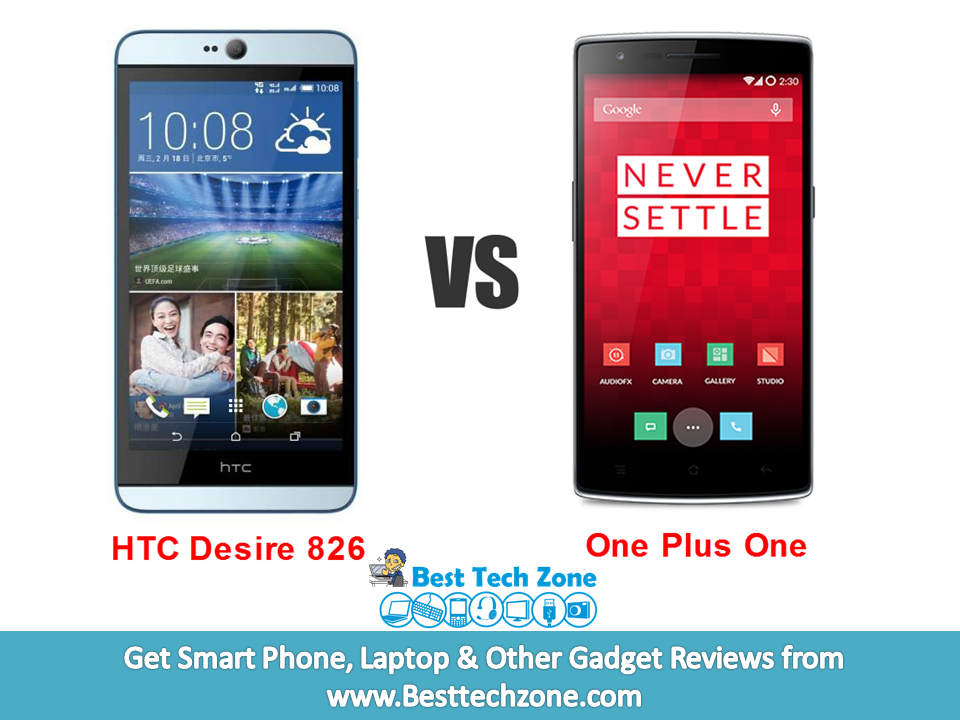
HTC Desire 826 vs OnePlus One comparison

HTC Desire 826 and OnePlus One are the new flagships of different smartphone manufacturing companies. Both are having amazing features and specifications at their price range. Are you not able to choose which is the best to buy? Do you want to compare HTC Desire 826 vs OnePlus One?

Don’t worry friends, for the sake of you people here we are giving detailed comparison of HTC Desire 826 and OnePlus One. Let’s check out HTC Desire 826 vs OnePlus One Comparison  and find out which one is the best for you.

HTC Desire 826 vs OnePlus One

Design & display

The OnePlus One 64GB will make you oggle at the 5.5-inch IPS LCD multi touch panel which offers pristine image quality, brilliant off-axis angles and super rich colors with a full HD resolution of 1,080 x 1,920 pixels and a high pixel density of 401 ppi. The display is secured against scratches and smudges with the Corning Gorilla Glass 3.0. The 8.9mm thick outfit has a weight of just 162 grams so that you can lug around with it easily. The dull leather like finish at the back enhances its appearance.

HTC Desire 826 sports a 5.5-inch Super LCD3 capacitive touchscreen with Full HD display (1920 x 1080 pixels) that turns out a great pixel density of 401 PPI just like OnePlus One.

HTC Desire 826 vs OnePlus One

Hardware and OS

HTC Desire 826 carries a 64-bit Qualcomm MSM8939 Snapdragon 615 chipset bearing a 1.7GHz Cortex A-53 quad-core processor and 1.0GHz Cortex A-53 quad-core processor. It combines with 2GB DDR3 RAM and Adreno 405 GPU to ensure smooth and fast performance. It runs on the latest Android v5.0 Lollipop OS.

Under the hood, OnePlus One carries a mighty Qualcomm Snapdragon SoC bearing a 2.5GHz quad-core processor and paired with an equally strong 3GB RAM. This gives you the opportunity to run all kinds of powerful applications simultaneously without facing any lag. Rich graphics is ensured by Adreno 330 GPU. It runs Android v4.4 KitKat OS out of the box.

Camera and Storage

The HTC Desire 826 is armed with a 13MP autofocus snapper with LED flash, face detection, HDR, geo-tagging, digital image stabilization and touch focus and ability to shoot full HD videos at 30fps and slow-mo 720p ones at 60fps. At the front, there is a 4MP ultra pixels camera which has 1/3” sensor size and 2?m pixel size.
The smartphone has 16GB of internal memory which is further expandable up to 128GB.
HTC Desire 826 vs OnePlus One
When coming to the OnePlus One 64GB, it features a stunning 13MP autofocus rear camera inclusive of dual LED flash, HDR and Exmor R CMOS image sensor so that you can capture razor sharp pictures even in the dark. You can also shoot 2160p videos at 30fps, 1080p at 60fps and 720p videos at 120fps. It is complemented by a brilliant 5MP front shooter. As the name indicates, it has a massive 64GB of onboard storage which is non-expandable.

Battery and Connectivity

The HTC Desire 826 sips juice from a sealed 2,600mAh Li-Po battery and sports high end connectivity features like 4G LTE Cat4, OTA Sync, GPS/A-GPS, GLONASS, DLNA, Bluetooth v4.0, tethering, Mobile hotspot, USB port and Wi-Fi Direct. It has stereo speakers and supports BoomSound and Dolby software.

Where as the OnePlus One is fuelled by a sealed 3,100mAh Li-Po battery. The OnePlus One 64GB sports connectivity features such as 4G (specific brands), 3G, GLONASS, WiFi, USB port, GPS/AGPS, Bluetooth v4.0 with A2DP and NFC.
PRICE Rs.22,799   Rs.21,998
OS Android OS, v5.0.1 (Lollipop) Android OS, v4.4.2 (KitKat), upgradable to v4.4.4 (KitKat)
CPU Quad-core 1.7 GHz Cortex-A53 & quad-core 1.0 GHz Cortex-A53 Quad-core 2.5 GHz Krait 400
RAM 2 GB RAM 3 GB RAM
SCREEN 5.5 inches (~68.1% screen-to-body ratio) 5.5 inches (~71.9% screen-to-body ratio)
DISPLAY 1080 x 1920 pixels (~401 ppi pixel density) 1080 x 1920 pixels (~401 ppi pixel density)
SIM Dual SIM (Nano-SIM, dual stand-by) Single SIM (Micro-SIM)
CAMERA Rear Camera: 13 MP, Front Camera: 4 MP, LED Flash: Yes Rear Camera: 13 MP, Front Camera: 5 MP, LED Flash: Yes
MEMORY Internal Storage 16 GB, microSD upto 128 GB Internal Storage 64 GB
BATTERY Non-removable Li-Po 2600 mAh battery Non-removable Li-Po 3100 mAh battery
OTHERS 4G, 3G, Bluetooth 4.1, WiFi, GPS 4G, 3G, Bluetooth, WiFi, GPS


Verdict

Coming to the final call, we can say that HTC offers all-round performance and a trust factor as well, which is very important while spending money around 25k so, the HTC Desire 826 offers everything we desire in a great smartphone and hence, as a better overall package it is the winner in HTC Desire 826 vs OnePlus One comparison. However, One Plus One with amazing performance and great features is not a bad choice either.

ALSO SEE

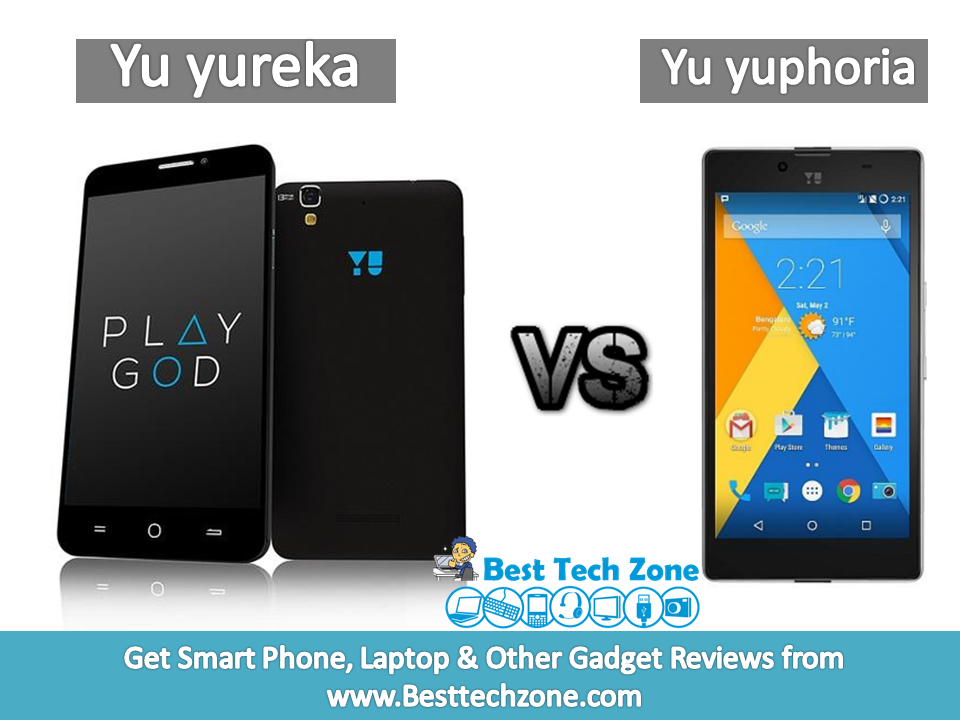
Micromax Yu Yureka vs Yu Yuphoria

Yu yureka and Yu yuphoria are the new flagships of india smartphone manufacturing company Micromax. Both are having amazing features and specifications at their price range. Are you not able to choose which is the best to buy? Do you want to compare micromax yu yureka and yu yuphoria?

Don’t worry friends, for the sake of you people here we are giving detailed comparison of yureka and yuphoria. Let’s check out Micromax Yu Yureka vs Yu Yuphoria Comparison  and find out which one is the best for you.

Micromax Yu Yureka vs Yu Yuphoria

Design and Display:

YU Yuphoria comes with candy-bar rectangular shape, with metallic lining all around the contours of the phone, providing true premium feel, and also giving a sense of better grip and sturdy structure to the device to withstand any accidental drop. It measures 8.5 mm in thickness.

On the front, it sports 5.0-inch HD (1280x720p) IPS TFT screen with full lamination, Gorilla Glass 3 shield and anti-fingerprint coating, and pixel density of 294 ppi (pixels per inch). The Micromax YU Yureka comes with ergonomic sloping edge design with a bulge in the middle (on the rear-side). It measures 8.8 mm thick in the middle and tapers down to 6.0 mm thickness at the edge.

 In terms of display specifications, it sports a 5.5-inch HD (720x1280p) screen with 80-degree viewing angle. But due to it’s bigger, foot-print screen, the phone’s display resolution comes down to 267 ppi.
Micromax Yu Yureka vs Yu Yuphoria

Processor, RAM and storage capacity:

When Micromax YU Yureka made its debut in December 2014 (released in January), it raised the bar for mid-range smartphones by incorporating advanced 64-bit class Snapdragon 615 Octa-core CPU.

YU has incorporated 64-bit class Snapdragon 410 series quad-core CPU inside the Yuphoria.

One advantage of having 64-bit processor is that the phone performance and RAM management will be optimized and efficiently used among the apps. Users are less likely to face lag during multi-tasking.

Yureka’s Snapdragon 615 processor is backed by Adreno 405 graphics engine, 2GB DDR3 RAM and 16GB inbuilt memory with an option of expansion up to 32GB via microSD card.

On the other hand, Yuphoria’s Snapdragon 410 chipset is also supported by sumptuous 2GB RAM and 16GB with option for expansion up to 32GB via microSD card.

Camera Specifications:

Micromax YU Yureka packs a 13.0-megapixel camera with Sony Exmor RS sensor, Blue-lens architecture, 5-physical element lens, full HD (1080p) resolution recording, LED flash and a pretty decent 5.0-megapixel camera, which is certain to cheer selfie enthusiasts.

On the other hand, Yu, in order to cut costs, it has made some trade-offs in the camera department of the Yuphoria.

Yuphoria ships with a 8.0-megapixel camera with LED flash, full HD video recording ability. But on the front, it boasts more superior 5mp snapper with f/2.0 aperture 4-physical element lens, 86-degree wide-angle photo capture ability.

Operating System:

Both Micromax YU devices stand even as they run on the same feature-rich Cyanogen custom Android OS.

YU Yuphoria comes with Cyanogen OS 12 (Android 5.0 Lollipop) out-of-the-box, whereas the Yureka just got updated to the same OS version last month.

Advantages of using Cyanogen OS include option to remove any app (even the pre-loaded ones which come with the phone), enhanced performance, better RAM management, regular security updates, quick settings configuration option, regular monthly update, privacy guard (gives users the control to what the applications can learn about you and your contacts),Global Blacklist (gives users the ability to flag telemarketers, robo-callers, annoying people and blacklist them) and many other customization options.


PRICE
Rs. 8,999 @ RS. 6,999
OS Android OS, v4.4.4 (KitKat), upgradable to v5.0.2 (Lollipop) Android, v5.0 (Lollipop)
CPU Quad-core 1.7 GHz Cortex-A53 & quad-core 1.0 GHz Cortex-A53 1.2GHz quad-core Qualcomm Snapdragon 410
RAM 2 GB RAM 2 GB RAM
SCREEN 5.5 inches (~69.1% screen-to-body ratio) 5.0 inches
DISPLAY 720 x 1280 pixels (~267 ppi pixel density) 720 x 1280 pixels (~ 267 PPI pixel density)
SIM Dual SIM (Micro-SIM, dual stand-by) Dual SIM (Micro-SIM, dual stand-by)
CAMERA Rear Camera: 13 MP, Front Camera: 5 MP, LED Flash: Yes Rear Camera: 8 MP, Front Camera: 5 MP, LED Flash: Yes
MEMORY Internal Storage 16 GB, microsd expandable upto 32 GB Internal Storage 16 GB, microSD, Upto 32 GB
BATTERY Li-Po 2500 mAh battery 2230 mAH, Li-Po Battery
OTHERS 4G, 3G, Bluetooth, WiFi, GPS, 4G,3G, Bluetooth, WiFi, GPS


At last few honest words, Micromax Yu Yureka vs Yu Yuphoria Comparison saying that  both smartphone hidden tones of features according to their price range. Now it’s on you what you want.
Also See

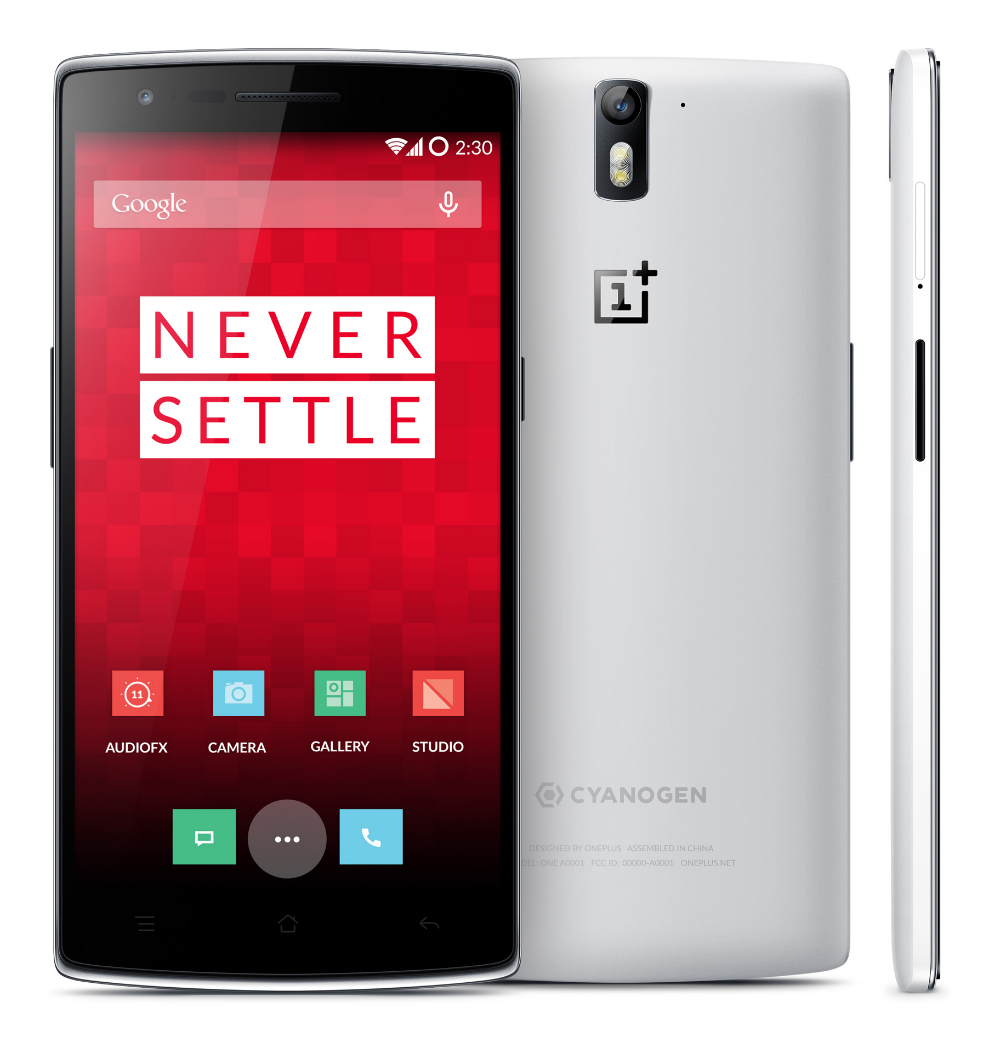
Oneplus One Vs Xiaomi mi4

Oneplus One Vs Xiaomi mi4

Design

The OnePlus One (Review | Photos) is larger than the Xiaomi Mi 4 (Review | Photos), at 152.9×75.9mm compared to 139.2×68.5mm. Both phones are 8.9mm thick, but the OnePlus One is also heavier. The Mi 4 is therefore easier to hold and use in one hand. More importantly, the One has a very rough matte texture on the sides and rear, which a number of customers have found unpleasant. The Mi 4 has plastic front and rear panels but a metal frame with bevelled edges. While Xiaomi’s design has hints of Apple and Samsung, the OnePlus One definitely looks original. Also, while the Mi 4 is only available in white in India, the One is only available in black.

Display

The OnePlus One has a 5.5-inch screen while the Mi 4’s measures 5 inches diagonally. Both have a common resolution of 1080×1920, which means the Mi 4 is quite a bit sharper. Both are comparable in terms of screen quality and viewing angles.

Oneplus One Vs Xiaomi mi4

Hardware

Both phones use the same SoC, Qualcomm’s Snapdragon 801, which has four CPU cores running at 2.5GHz and an Adreno 330 GPU. Both phones also have 3GB of RAM. The OnePlus One supports LTE on Indian bands while the Mi 4 does not.

software

This is easily the biggest differentiator between two very evenly matched competitors. The OnePlus One made a name for itself based on the promised Cyanogen OS, which due to legal issues will not materialise for Indian buyers. Current devices being sold still ship with Cyanogen OS, but updates will not be released and users will have to flash their phones when OnePlus’ in-house Oxygen OS is released. It is not yet known how much of Cyanogen’s power and customisability will be carried over to Oxygen OS. Cyanogen OS definitely looks rough, but has dozens of useful little tweaks that will be difficult to live without once you’re used to them.

Oneplus One Vs Xiaomi mi4

On the other hand, Xiaomi’s approach has always been to reduce complexity and make things look attractive, which is why the emphasis is on slick packaging that borrows heavily from Apple’s design handbook. Xiaomi’s MIUI dispenses with the Android app drawer and so all icons and widgets live on the homescreens.

Both software ecosystems run on top of Android 4.4 and offer loads of customisation in the form of downloadable themes.

Cameras

Both, the Xiaomi Mi 4 and the OnePlus One have 13-megapixel rear cameras capable of recording 4K video at 30fps. In our tests, we found both performed well in daylight but had issues in low-light conditions. The Mi 4 generally produced photos with brighter, more vibrant colours while the OnePlus One produced duller colours but surfaced more detail. The two trade blows evenly, though we preferred the more natural tones of the OnePlus One.

In terms of the camera apps, Xiaomi has done a good job integrating multiple functions and making options easy to get to. Once again, if simplicity and usability are more important, this is the way to go.

Oneplus One Vs Xiaomi mi4

Storage

Interestingly, while both are available internationally in 16GB and 64GB variants, Xiaomi has launched only the 16GB version of the Mi 4 here in India (so far) while OnePlus only offers the 64GB One. Neither device has a microSD card slot for storage expansion.

PRICE Rs.21,998   Oneplus one Vs Xiaomi mi4 RS.12,999  
OS Android OS, v4.4.2 (KitKat), upgradable to v4.4.4 (KitKat) Android OS, v4.4.3 (KitKat)
CPU Quad-core 2.5 GHz Krait 400 Quad-core 2.5 GHz Krait 400
RAM 3 GB RAM 3 GB RAM
SCREEN 5.5 inches (~71.9% screen-to-body ratio) 5.0 inches (~72.3% screen-to-body ratio)
DISPLAY 1080 x 1920 pixels (~401 ppi pixel density) 1080 x 1920 pixels (~441 ppi pixel density)
SIM Single SIM (Micro-SIM) Single SIM (Micro-SIM)
CAMERA Rear Camera: 13 MP, Front Camera: 5 MP, LED Flash: Yes Rear Camera: 13 MP, Front Camera: 8 MP, LED Flash: Yes
MEMORY Internal Storage 64 GB Internal Storage 16 GB
BATTERY Non-removable Li-Po 3100 mAh battery Non-removable Li-Ion 3080 mAh battery
OTHERS 4G, 3G, Bluetooth, WiFi, GPS 4G, 3G, Bluetooth, WiFi, GPS


Which One id better ?

In all honesty, it is a tight call between the OnePlus One and the Xiaomi Mi 4. In terms of core hardware functionality, the Mi 4 comes out on top in terms of display quality, camera quality and build quality. However, if you are looking at the complete package, then the OnePlus One is the one to go for as it adds 4G support, and has significantly more memory. The OnePlus One is also likely to get Android updates faster and in general usage it feels like the faster phone.

But at the same time, the One Plus One also costs Rs.2,000 extra.

If you do not mind the limited memory and the omission of 4G support then the Mi 4 is the better phone. But if you need 4G and is willing to spend Rs.2,000 more for it, One Plus One is the phone for you.


Also See

Xiaomi Redmi 2 vs lenovo A6000 Comparison

We have now got many great low-budget smartphones and these low budget smartphones are tempting many customers to get confused in deciding which one they should buy. Today we have got a showdown of two of the finest low-budget phones – The Xiaomi redmi 2  Vs Lenovo A6000.

Xiaomi launched its Redmi 2 and it got very huge response for its heavy specifications under the low price range of Rs. 8,000. It came out as a beast of the phones and delivered huge success to Asus.

Lenovo is tasting success since launch Lenovo A6000. Lenovo now come even stronger with its new launch –A6000. Priced at just Rs. 8,000, it will be a tough competition to Micromax yu yureka, Asus Zenfone 2 and many low-budget killers.

After arrival of Redmi 2 ,Lenovo A6000  will  lose its position? Well, let’s check it out by comparing them in details:

Xiaomi Redmi 2 vs lenovo A6000 :

Price   Rs. 6,999 @    Rs. 8,151 @ 
OS Android OS, v4.4.4(KitKat) Android OS, v4.4.4 (KitKat)
CPU Quad Core 1.2 GHz Qualcomm Snapdragon 410 Quad-core 1.2 GHz Qualcomm Snapdragon 410 Processor
RAM 1 GB RAM 1 GB RAM
SCREEN 4.7 inches, IPS LCD capacitive touchscreen, Corning Gorilla Glass 2 5.0 inches, IPS capacitive touchscreen
DISPLAY 1280 x 720 pixels, 312 ppi pixel density 720 x 1280 pixels, 294 ppi pixel density
SIM Dual SIM, GSM + GSM Dual SIM (Micro-SIM)
CAMERA Primary Camera: 8 MP, Secondary Camera: 2 MP, Flash: Yes Rear Camera: 8 MP, Front Camera: 2 MP,  LED Flash: Yes
MEMORY Internal Storage 8 GB, microSD Expandable upto 32 GB Internal Storage 8 GB, microsd expandable upto 32 GB
BATTERY Li-Po 2200 mAh battery Li-Po 2300 mAh battery
OTHERS 3G, 4G, Bluetooth, WiFi, GPS, Quick Charge 1.0 4G, 3G, Bluetooth, WiFi, GPS


Design :

At first, it would seem that the Xiaomi Redmi 2 is not much different from its predecessor in terms of looks. But the new version is actually shorter, narrower and thinner than the original Redmi design. Dimensions of the new phone are 134 x 67.2 x 9.4 mm, compared to the Redmi 1S’ 137 x 69 x 9.9 mm.

The Lenovo A6000 has a large footprint, due to the bigger screen when compared to the Redmi 2. The Lenovo A6000 measures 141 x 70 x 8.2 mm and weighs 128 grams. The Lenovo A6000 has fairly thin bezels, making it a more attractive package on the face of it.

Xiaomi Redmi 2 vs lenovo A6000

While the Redmi 2’s back panel has a rubberised finish, the A6000’s back cover has a matte finish – both are not slippery and give good grip.

Display :

With the bigger size, the A6000 also flaunts a bigger 5-inch display as compared to the Redmi 1S’ 4.7-inch display. Both the devices however feature HD (1280×720 pixels) resolution. The difference in size makes a small difference in the pixel density as well, and where the A6000’s display has a pixel density of 294ppi, the Redmi 2 has a density of 312ppi.

Xiaomi Redmi 2 vs lenovo A6000


Processor,OS & Memory :

The Xiaomi Redmi 2 has a quad-core 1.2 GHz Snapdragon 410 processor. It has been launched in India with 8 GB internal storage which has got 1 GB of RAM. Besides the phone has Adreno 306 graphics processor and a 32 GB micro SD card slot.

The Lenovo A6000 also has the 1.2 Ghz, 64 bit Qualcomm Snapdragon 410 quad core processor, Adreno 306 graphics processor and 1 GB RAM. It too offers internal memory of 8 GB and a 32 GB micro SD card slot.

Xiaomi Redmi 2 vs lenovo A6000


The Lenovo A6000 runs on Android KitKat and has Lenovo’s Vibe 2.0 UI. Lenovo’s own UI adds another skin on the stock Android and has a few additional features.

The Xiaomi Redmi 2 too runs on Android KitKat, but has the latest MiUI 6.0 interface.

Battery :

The Xiaomi Redmi 2 has a 2200 mAh battery, but Xiaomi has not specified how much back up it will be able to provide.

The Lenovo A6000 is though pretty impressive with its 2300 mAh battery. The A6000 comfortably managed to offer a day’s back up.

Cameras :

Things are again identical in this department with both the devices featuring an 8-megapixel camera at the back, supplemented by a 2-megapixel camera at the front.

Xiaomi Redmi 2 vs lenovo A6000

Connectivity :

The Xiaomi Redmi 2 is a dual-SIM phone with 4G, Bluetooth 4.0, GPS, WiFi, and WiFi hotspot.

The Lenovo A6000 is a dual-SIM phone too and it also offers 4G, Bluetooth 4.0, GPS, WiFi, and WiFi Hotspot. However, unlike Redmi 2, it accepts only one 4G SIM while the other slot is meant for 2G cards.

Conclusion

Both the smartphones are priced at Rs 6,999 and arrive with almost similar aspects. Especially, both are entry level 4G LTE capable smartphones. Of the two, the Xiaomi phone seems to be better with a better display that will be relatively sharper as it packs in more pixels. But, Lenovo is already struggling to cater to the needs of all the customers who want to buy its A6000 and Xiaomi is already known for its flash sales model.

Also See

Samsung Galaxy S6 Vs S6 Edge Comparison

Samsung has just released unto the world two of the finest devices it has ever produced. The Galaxy S6 and Galaxy S6 Edge are at the top of the Android pile in terms of technology, but which is better? With much the same innards, the big difference comes down to the screen. Is the S6 Edge worth the additional cost for its curvy display? Find out in our Samsung Galaxy S6 Vs S6 Edge comparison.

Samsung Galaxy S6 Vs S6 Edge Comparison

PRICE Rs 49,900 @  Samsung Galaxy S6 Vs S6 Edge Comparison Rs.61,900 @ Samsung Galaxy S6 Vs S6 Edge Comparison
OS Android OS, v5.0.2 (Lollipop) Android OS, v5.0.2 (Lollipop)
CPU Quad-core 1.5 GHz Cortex-A53 & Quad-core 2.1 GHz Cortex-A57 Quad-core 1.5 GHz Cortex-A53 & Quad-core 2.1 GHz Cortex-A57
RAM 3 GB RAM 3 GB RAM
SCREEN 5.1 inches (~70.7% screen-to-body ratio) 5.1 inches (~71.7% screen-to-body ratio)
DISPLAY 1440 x 2560 pixels (~577 ppi pixel density) 1440 x 2560 pixels (~577 ppi pixel density)
SIM Single SIM (Nano-SIM) Single SIM (Nano-SIM)
CAMERA Rear Camera: 16 MP, Front Camera: 5 MP, LED Flash: Yes Rear Camera: 16 MP, Front Camera: 5 MP, LED Flash: Yes
MEMORY Internal Storage 32/64/128 GB Internal Storage 32 GB
BATTERY Non-removable Li-Ion 2550 mAh battery Non-removable Li-Ion 2600 mAh battery
OTHERS 4G, 3G, Bluetooth, WiFi, GPS 4G, 3G, Bluetooth, WiFi, GPS


Samsung Galaxy S6 :

Samsung Galaxy S6 Vs S6 Edge Comparison

The leading smartphone brand, Samsung is officially announced the new Samsung Galaxy S6 smartphone. Samsung Galaxy S6 price in India is around INR 49,990. Galaxy S6 is expected to be a new generation of smartphones which ultra smart features like wireless charging. S6 is being eyed as the toughest rival against Apple iPhone 6. Following are the detailed Samsung Galaxy S6 specifications and review.

DESIGN AND HARDWARE

Samsung Galaxy S6 is a sleek device with metal finish along the edges. Galaxy S6 specifications highlight a Cortex A-53, 1.3/1.9 Ghz quad-core. It is expected to wrap 3 GB RAM which would make it one of the fastest processing units across its price segment. It has an inbuilt memory of 32 GB and supports micro SD card upto 128 GB. Samsung Galaxy S6 battery is expected to be a Li-ion setup. The graphic acceleration is empowered by a Mali-T760 GPU.

OPERATING SYSTEM AND SOFTWARE FEATURES

Samsung Galaxy S6 is expected to house the latest Android Lollipop v5.0. This device seems to revolutionize the smartphone era of the modern world. The phone includes Bluetooth 4.0, WiFi, A-GPS with GLONAS, supports LTE. Apart from this, Samsung Galaxy S6 runs unique features like air gesture sensor and heart rate sensor along with gyroscopic and compass sensors.

CAMERA AND DISPLAY

Samsung Galaxy S6 is expected to sport a 16 MP autofocus primary camera with face detection, touch focus, optical image stabilization and flash by its side. The primary camera is expected to include a high resolution of 4992×3754 pixels. The 16 MP camera is capable of simultaneous 2160p video and image recording, which gives it a head start in the race. The 5 MP front camera is capable of 1080p video recording at 30fps with smart feature of dual video call.

The 5 inch SUPER AMOLED display is expected to be an HD display with a resolution of 2560×1440 pixels and a multipoint capacitive touchscreen.


Samsung Galaxy S6 Edge :

Samsung Galaxy S6 Vs S6 Edge Comparison

Recently at Mobile World conference 2015 in Barcelona, Samsung introduced the most brilliant flagship smartphones ever made by itself, Samsung Galaxy S6 and Galaxy S6 Edge. Galaxy S6 Edge feature an improvised version of the curved display technology previously incorporated by Samsung Galaxy Note Edge. Galaxy S6 Edge features the curved display on both ends, absence of which was considered to be a drawback of Note Edge.

DESIGN AND HARDWARE

Galaxy S6 EDGE specifications highlight a 1.5 GHz octa-core Exynos processor which is formed by a combination of Quad-core 1.5 GHz Cortex-A53 & Quad-core 2.1 GHz Cortex-A57. It packs 3 GB RAM which would make it one of the fastest processing units across its price segment. It has an inbuilt memory of 32 GB and provides no micro SD card slot. Samsung Galaxy S6 EDGE battery is a 2600 mAh Li-ion setup. A Mali-T760 GPU is responsible for an excellent graphic performance.

OPERATING SYSTEM AND SOFTWARE FEATURES

Samsung Galaxy S6 EDGE is based on the latest Android version, Lollipop v5.0.2. The phone possesses Bluetooth 4.0, WiFi, A-GPS with GLONAS, supports LTE. Apart from this, Samsung Galaxy S6 EDGE runs unique features like air gesture sensor and heart rate sensor along with gyroscopic and compass sensors.

CAMERA AND DISPLAY

Samsung Galaxy S6 EDGE sports a 16 MP autofocus primary camera with face detection, touch focus, optical image stabilization and flash by its side. The primary camera has a high resolution of 5312×2988 pixels. The 16 MP camera can record simultaneous 2160p video and image. The 5 MP front camera is capable of 1440p video recording at 30fps with smart feature of dual video call.

The 5 inch SUPER AMOLED display is an HD display with a resolution of 2560×1440 pixels and a multipoint capacitive touchscreen. The display is uniquely curved on both sides which would serve separately while the phone is locked. And when it is not, the edge displays serve normally as a part of normal display.

Final Verdict

These are two of the highest quality handsets you will currently find on Android. Samsung has taken all that was good about its previous Galaxy designs and produced the best iterations yet. Whichever device you choose you’ll receive great charging features, an amazing camera and a stunning display.

If you want a decision on which is better, I’ll go with the S6 Edge. It’s more than just a gimmick, it’s an innovation that truly has the potential to influence the way all smartphones are made. Samsung has made simply looking and controlling your phone feel better. Curved screens are no longer that far-off technology that may be worth a look some day in the distant future. They’ve arrived, and thanks to the Galaxy S6 Edge, they’re really good.

Also See

Samsung Galaxy S6 Vs iphone 6 Comparision

Both Samsung Electronics Co. and Apple Inc. have taken the smartphone market by storm — each with not just one device, but two.

Apple released the iPhone 6 and the iPhone 6 Plus in last year. Both devices feature the largest screens ever on Apple smartphones, but the iPhone 6 Plus is Apple’s first phablet: A cross between a tablet and a smartphone. Its extra large display lured away many phablet fans that only stuck with their Samsung or other Android smartphones because those were the only phablet options.

Samsung released the Galaxy S6 and the Galaxy S6 Edge lthis year. Both devices include some of the most advanced hardware, software and services specifications ever featured on a Samsung smartphone, but the Galaxy S6 Edge is currently the only smartphone on the market to feature a dual-curved display. It has the potential to attract consumers who want to play with the latest technology available.

Recent reports have compared the Galaxy S6 to the iPhone 6,noting while the Galaxy S6 is more expensive for Samsung to make, the iPhone 6 is more expensive for consumers to purchase. But will price matter to consumers when both devices are extremely expensive?

If you can’t decide between the Galaxy S6 and the iPhone 6,take a look at our comparison to help you make a choice.

Samsung Galaxy S6 vs iphone 6

PRICE Rs.61,900 @   Rs.59,000 @
OS Android OS, v5.0.2 (Lollipop) iOS 8, upgradable to iOS 8.3
CPU Quad-core 1.5 GHz Cortex-A53 & Quad-core 2.1 GHz Cortex-A57 Dual-core 1.4 GHz Cyclone (ARM v8-based)
RAM 3 GB RAM 1 GB RAM
SCREEN 5.1 inches (~71.7% screen-to-body ratio) 4.7 inches (~65.8% screen-to-body ratio)
DISPLAY 1440 x 2560 pixels (~577 ppi pixel density) 750 x 1334 pixels (~326 ppi pixel density)
SIM Single SIM (Nano-SIM) Single SIM (Nano-SIM)
CAMERA Rear Camera: 16 MP, Front Camera: 5 MP, LED Flash: Yes Rear Camera: 8 MP, Front Camera: 1.2 MP, LED Flash: Yes
MEMORY Internal Storage 32 GB Internal Storage 64 GB
BATTERY Non-removable Li-Ion 2600 mAh battery Non-removable Li-Po 1810 mAh battery (6.9 Wh)
OTHERS 4G, 3G, Bluetooth, WiFi, GPS 4G, 3G, Bluetooth, WiFi, GPS


Samsung Galaxy S6 :

Samsung Galaxy S6 Vs iphone 6

The leading smartphone brand, Samsung is officially announced the new Samsung Galaxy S6 smartphone. Samsung Galaxy S6 price in India is around INR 49,990. Galaxy S6 is expected to be a new generation of smartphones which ultra smart features like wireless charging. S6 is being eyed as the toughest rival against Apple iPhone 6. Following are the detailed Samsung Galaxy S6 specifications and review.

Design and hardware

Samsung Galaxy S6 is a sleek device with metal finish along the edges. Galaxy S6 specifications highlight a Cortex A-53, 1.3/1.9 Ghz quad-core. It is expected to wrap 3 GB RAM which would make it one of the fastest processing units across its price segment. It has an inbuilt memory of 32 GB and supports micro SD card upto 128 GB. Samsung Galaxy S6 battery is expected to be a Li-ion setup. The graphic acceleration is empowered by a Mali-T760 GPU.

Operating System and Software Features

Samsung Galaxy S6 is expected to house the latest Android Lollipop v5.0. This device seems to revolutionize the smartphone era of the modern world. The phone includes Bluetooth 4.0, WiFi, A-GPS with GLONAS, supports LTE. Apart from this, Samsung Galaxy S6 runs unique features like air gesture sensor and heart rate sensor along with gyroscopic and compass sensors.

Camera and Display

Samsung Galaxy S6 is expected to sport a 16 MP autofocus primary camera with face detection, touch focus, optical image stabilization and flash by its side. The primary camera is expected to include a high resolution of 4992×3754 pixels. The 16 MP camera is capable of simultaneous 2160p video and image recording, which gives it a head start in the race. The 5 MP front camera is capable of 1080p video recording at 30fps with smart feature of dual video call.

The 5 inch SUPER AMOLED display is expected to be an HD display with a resolution of 2560×1440 pixels and a multipoint capacitive touchscreen.

Apple iphone 6 :

Samsung Galaxy S6 Vs iphone 6

The iPhone 6 features a 4.7-inch Retina HD (750 x 1334 pixels) resolution display.The iPhone 6  features Apple’s dual-core A8 processor. Apple claims its chip is 25 percent faster and 50 percent more power efficient than its previous A7 chip, found in older products like the iPhone 5s and iPad Air.

Apple introduced a completely new design with the iPhone 6. In addition to making the device bigger, it favored a design with more rounded corners over the boxy designs of older iPhones. Instead of a glass back panel, Apple made the iPhone almost entirely out of metal, giving the material a matte finish.

The iPhone 6 includes a Non-removable Li-Po 1810 mAh battery (6.9 Wh), which Apple claims allows for as much as 24 hours of talk time on a 3G network, 14 hours of video play, 80 hours of music play and 12 hours of 3G Internet use, 12 hours of LTE Internet use and 12 hours of Wi-Fi Internet use.The iPhone 6 is charged via a USB 2.0 enabled lightning charger.

The iPhone 6 features an 8-megapixel rear camera with optical image stabilization and 1.2-megapixel front camera. The camera includes an f/2.2 aperture lens, which is a camera standard.  Apple included features such as slow motion and time lapse on the iPhone 6 camera app.

The iPhone 6  features the iOS 8 operating system, which has features including third-party keyboards, interactive notifications, Touch ID development, and updates to spotlight, mail, messages and other applications.

The iPhone 6 Plus includes 1GB of RAM and 16GB, 64GB and 128GB internal storage options. Many complain Apple has not increased its RAM capaciy in several devices, but the smartphone-maker says the iPhone 6 is optimized so it doesn’t need as much RAM.

The iPhone 6 starts at 16GB of internal storage, but its next tier offers three times the space for $100 more. The iOS 8 operating system takes up about 3GB total memory, leaving users with about 13GB for their own use.  This is a decent capacity, but it can fill up easily with photos and music. For this reason, the 64GB option may be the most viable option for most users.

The iPhone 6 is compatible with 2G, 3G and 4G LTE networks and is powered by a single network SIM card.Its connectivity features include the latest Wi-Fi and Bluetooth standards, USB 2.0, GPS, Glonass and iBeacon location technology and a 3.5mm Stereo jack.

Verdict

It goes without saying now that our phone choices are usually dictated by the software ecosystem we like best: Android or iOS. I don’t think the changes Samsung has made to the S6 series will be enough to make hardcore iPhone fans switch, but it will almost certainly light a fire under Apple’s ass to improve the hardware, specs and features (like wireless charging) inside its next-generation iPhone. But if you’re on the fence and don’t really care about the OS you use, the Samsung S6 series has some compelling features the iPhone lacks: mainly a much better camera and a more beautiful display.

Samsung should be commended for turning its lackluster S5 into something beautiful with the S6 series. Design is now taking centre stage within Samsung, and this is definitely a good thing because the hardware and specs have always been great –– we just wanted something that looked nice. With the Galaxy S6 and Galaxy S6 EDGE, Samsung has shown it can no design with the best of them –– Apple included.


Also See