Black landscaping stones have become a popular choice for enhancing the aesthetic appeal of outdoor spaces. As a supplier of high – quality black landscaping stones, I often receive inquiries about their weight per square foot. This is a crucial factor for various reasons, including transportation planning, installation feasibility, and structural considerations of the area where the stones will be placed. Black Landscaping Stones
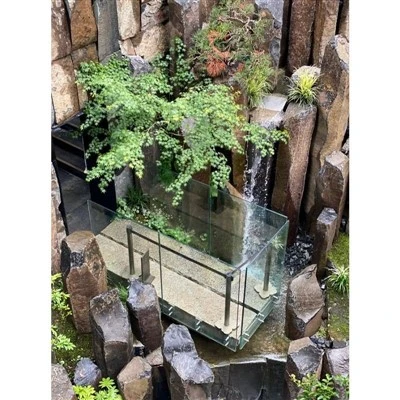
Understanding the Density of Black Landscaping Stones
The weight of black landscaping stones per square foot can vary significantly depending on their type, composition, and porosity. Not all black stones are created equal; for instance, basalt, a common type of black landscaping stone, is known for its high density. Basalt is an igneous rock formed from the rapid cooling of lava. Its fine – grained texture and compact structure give it a relatively high weight.
On average, basalt can weigh around 165 to 180 pounds per cubic foot. To translate this to weight per square foot, we need to consider the thickness of the stone. For example, if we assume a 1 – inch thick (or 1/12 – foot thick) layer of basalt, we can calculate the weight per square foot using the following steps.
The volume of a 1 – square – foot area with a 1/12 – foot thickness is (V = 1\text{ ft}^2\times\frac{1}{12}\text{ ft}=\frac{1}{12}\text{ ft}^3).
If the density of basalt is 170 pounds per cubic foot, then the weight (W) of a 1 – inch thick, 1 – square – foot area of basalt is (W = \text{density}\times\text{volume}=170\text{ lb/ft}^3\times\frac{1}{12}\text{ ft}^3\approx14.17\text{ pounds}).
Another common type of black landscaping stone is slate. Slate is a metamorphic rock that can be split into thin sheets. It has a lower density compared to basalt, typically ranging from 150 to 160 pounds per cubic foot. Using the same calculation method for a 1 – inch thick layer, with a density of 155 pounds per cubic foot, the weight of a 1 – square – foot area of slate would be (W = 155\text{ lb/ft}^3\times\frac{1}{12}\text{ ft}^3\approx12.92\text{ pounds}).
Impact of Stone Thickness on Weight
The thickness of the black landscaping stones plays a vital role in determining their weight per square foot. Thicker stones naturally weigh more. For professional landscapers or DIY enthusiasts, understanding this relationship is essential for proper installation.
Let’s consider the case of using basalt as a walkway. If a 2 – inch thick (or 1/6 – foot thick) basalt slab is used, the volume of a 1 – square – foot area is (V = 1\text{ ft}^2\times\frac{1}{6}\text{ ft}=\frac{1}{6}\text{ ft}^3). With a density of 170 pounds per cubic foot, the weight per square foot would be (W = 170\text{ lb/ft}^3\times\frac{1}{6}\text{ ft}^3\approx28.33\text{ pounds}).
This increase in weight means that the base and supports for the walkway need to be more robust. Soil compaction, the use of a gravel base, or the installation of retaining walls might be necessary to ensure the structural integrity of the area where the thicker stones are placed.
Practical Implications for Landscaping Projects
When working on a landscaping project, the weight of black landscaping stones per square foot affects multiple aspects. For one, it influences the transportation costs. Heavier stones require more fuel to transport, and larger, more heavy – duty vehicles may be needed. This can significantly add to the overall project budget.
In terms of installation, the weight determines the number of workers required and the equipment needed. Lifting and placing heavy stones may require machinery such as forklifts or cranes, especially for large – scale projects. Additionally, the weight can impact the layout of the stones. If the area has a slope, heavier stones may be more likely to shift or cause erosion if not properly secured.
Factors Affecting Stone Density
Beyond the type of stone, other factors can affect the density and thus the weight per square foot. Porosity is one such factor. Some black stones may have small holes or pores within their structure. Stones with higher porosity will generally be lighter because there is more air space within the stone. For example, a porous black lava rock will have a lower density compared to a non – porous basalt.
The origin of the stone can also play a role. Different geological formations can result in variations in the mineral composition and density of the same type of stone. Stones from one quarry may have slightly different properties compared to those from another, even if they are of the same general type.
Estimating the Weight for Specific Projects
As a Black Landscaping Stones supplier, I often assist my clients in estimating the weight of the stones they need for their projects. First, we determine the total area of the space to be covered. Then, based on the type of stone the client has chosen and the desired thickness, we can calculate the weight per square foot and then the total weight.
For example, if a client wants to cover a 500 – square – foot area with 2 – inch thick basalt slabs, we know from our previous calculations that the weight per square foot of 2 – inch thick basalt is approximately 28.33 pounds. So the total weight of the stones needed would be (500\text{ ft}^2\times28.33\text{ lb/ft}^2 = 14165\text{ pounds}).
This information is invaluable for the client as it helps them plan for transportation, installation, and any necessary structural reinforcements.
Quality Assurance and Weight Consistency
At our supply, we take great pride in providing high – quality black landscaping stones. We conduct regular quality checks to ensure that the stones meet the expected density and weight standards. This consistency is crucial for our clients, as it allows them to accurately plan their projects without unexpected variations in the weight of the stones.
We source our stones from reliable quarries and use advanced testing methods to verify their properties. This means that whether our clients are installing a small garden feature or a large commercial landscape, they can rely on the weight of the stones being as expected.
Importance of Professional Advice
While it’s possible to calculate the weight of black landscaping stones per square foot using basic formulas, it’s highly recommended to seek professional advice. As a supplier with years of experience, I have witnessed firsthand the importance of proper planning based on accurate weight estimates.
Professional landscapers or our in – house experts can take into account all the factors specific to a project, such as the soil type, the intended use of the area, and local building codes. They can provide tailored advice on the best type of stone, the appropriate thickness, and the necessary preparations for installation.
Conclusion

In summary, the weight of black landscaping stones per square foot is a critical consideration for any landscaping project. It depends on the type of stone, its thickness, porosity, and origin. Understanding this weight is essential for transportation, installation, and ensuring the structural integrity of the area where the stones are placed.
Taihu Stone As a leading supplier of Black Landscaping Stones, we are committed to providing our clients with not only high – quality stones but also expert advice on all aspects of their projects. If you are planning a landscaping project and need black landscaping stones, or if you have any questions about their weight, coverage, or installation, we encourage you to contact us for a detailed consultation. Our team of experienced professionals is ready to assist you in making the best choices for your project.
References
- "Rocks and Minerals: A Guide to Identification and Classification", Geological Society of America Press.
- "Landscaping Handbook: Best Practices for Outdoor Design and Installation", Landscape Architects Association.
Orin International Trade Co., Ltd.
With abundant experience, we are one of the most professional black landscaping stones manufacturers and suppliers in China. We warmly welcome you to wholesale custom made black landscaping stones from our factory. If you have any enquiry about cooperation, please feel free to email us.
Address: No.3-1, Shangzhongdi Natural Village, Hexian Village, Shuangta Sub-district, Jiangshan City, Quzhou City, Zhejiang Province
E-mail: atlas@orinstone.com
WebSite: https://www.orinstone.com/
