Alright, let’s cut to the chase—if you’re deep in aerospace casting, you already know how one tiny defect can bring a whole part (and your timeline) to a screeching halt. From turbine blades that spin at 1,800 mph to landing gear components that take brutal impact, aerospace parts have zero room for error. That’s where alumina ceramic foam filters (CFFs) come in—and as someone who’s been supplying these filters for over a decade, I can tell you they’re not just a “nice-to-have” anymore. They’re the backbone of clean aerospace castings. Alumina Ceramic Foam Filter
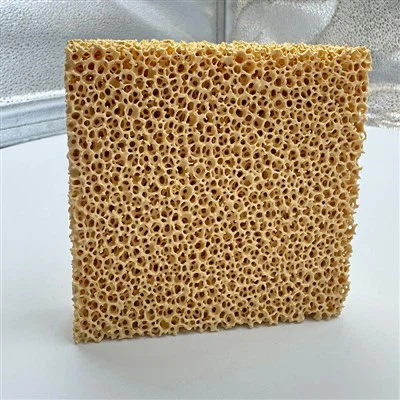
Let’s start with the basics for anyone new here: alumina CFFs are porous, lightweight blocks made mostly from aluminum oxide (that’s the “alumina” part) with a foamy, open-cell structure. Unlike other filters, they don’t melt or degrade in super-hot molten metal—think 1,600°C+ for titanium, nickel, or high-alloy steels, the stuff aerospace parts are cast from. But why do they matter specifically for aerospace casting? Because when you’re casting a component that could end up in a jet engine or a satellite, even a microscopic bit of slag, alumina inclusion, or ceramic particle can be a disaster. Those inclusions cause cracks, fatigue failure, or even full-on part rejection—and in aerospace, rejection isn’t just a cost issue. It’s a safety and compliance nightmare.
I’ve seen this firsthand with a client last year: they were casting turbine blades for a commercial jet engine, and their old filter (a mesh style, if you can believe it) was letting through tiny slag clumps. Half the batch failed X-ray inspection, setting their production back 3 weeks. We swapped in our standard alumina CFFs, and boom—98% of that batch passed first-time inspection. That’s the kind of win that makes aerospace casting teams sit up and take notice.
Now, let’s break down exactly where these filters show up in the aerospace casting process. First step: molten metal treatment. Before you even pour metal into a mold, you have to remove everything that’s not pure metal. When you’re dealing with aerospace-grade alloys, that’s non-negotiable. Alumina CFFs do this by capturing inclusions in their pore structure, not just on the surface (unlike mesh filters, which get clogged fast and only catch big stuff). The open-cell design also slows down molten metal just enough to let those heavy inclusions sink and get trapped, while the clean metal flows through at a steady, controlled rate—no turbulence, which is another big one. Turbulence causes oxidation in the metal, which creates more inclusions. We’ve had clients test that too: pouring through alumina CFFs cut oxidation-related defects by 70% in their titanium castings.
Next up: investment casting, which is the process for most complex aerospace parts like turbine blades, impellers, and structural brackets. Investment casting uses a wax pattern coated in ceramic slurry, so the mold is super precise—but it’s also tiny inclusions that mess things up here. Alumina CFFs are perfect because they’re chemically inert with the ceramic mold material, so they don’t contaminate the metal or the mold. A lot of people ask me “why not silicon carbide or zirconia filters?” Here’s the thing: alumina is cheaper, but it’s still durable enough for most aerospace alloys, and it doesn’t react with the molten aluminum, nickel, or titanium that’s common here. Zirconia might work for super-heavy titanium, but alumina hits the sweet spot for 80% of aerospace investment casting jobs—and that’s where most of our business comes from.
Wait, let’s talk about turbine blades specifically, because that’s a huge aerospace use case. Turbine blades are cast from single-crystal nickel superalloys, right? Any tiny inclusion in the molten metal can mess up the crystal structure, leading to defects that cause the blade to fail at high temperatures. Our alumina CFFs are sized for the specific gating system of single-crystal molds—we work with each client to cut the filter to fit their runner system, so there’s no extra turbulence and every bit of molten metal flows through clean. I had a client in Ohio a couple years back who was having issues with blade rejection because of “internal voids” from inclusions in the metal. After switching to our custom-cut alumina CFFs, their void rate dropped from 12% to less than 2%. That’s the difference between meeting a delivery deadline and losing a major contract.
Another big application: cast structural components for aircraft frames and landing gear. These parts are thick, made from high-strength steels or titanium, and they need to pass rigorous stress tests. Molten metal for these parts has a lot of slag from the melting process, and alumina CFFs are great at trapping that large, dense slag particles that would otherwise get stuck in thick sections of the casting. Mesh filters can’t handle the volume of metal needed for these big parts—they clog too fast, causing pressure spikes that break the mold gates. Our alumina CFFs have a higher porosity (usually 20-60 pores per inch, or PPI) so they can let more metal flow through without catching all the inclusions at once. That means you can pour a 500-pound titanium casting in one go, no stops, no clogs, no defects.
But it’s not just about catching inclusions—alumina CFFs also help with grain structure, which is huge for aerospace part performance. When molten metal flows smoothly through the filter, it doesn’t cool unevenly or form large, weak grains. Finer, more uniform grains mean the part is stronger, more resistant to fatigue, and can handle higher temperatures. For example, satellite components that go through extreme temperature swings (from -150°C in space to +150°C in direct sun) need that consistent grain structure to avoid cracking. We’ve had a space parts client who switched to our alumina CFFs for their aluminum satellite castings, and their parts now pass thermal cycle tests 100% of the time—up from 85% before. That’s the kind of reliability that space agencies demand.
Now, let’s get real about common misconceptions. A lot of casting teams think “I can just use a cheaper filter.” But in aerospace, the cost of a bad part is way higher than the cost of a good filter. Let’s do the math: a single aerospace turbine blade can cost $10,000+ to cast, and if it fails inspection, you’re out that money plus the cost of the mold, labor, and delay. Our alumina CFFs cost pennies per part, but they save thousands in rejected batches and rework. I’ve had clients tell me they spent $50k on rework last quarter before switching to our filters—now they spend $5k on filters and that rework cost is gone. That’s a no-brainer.
Another myth: “alumina filters can’t handle titanium.” Wait, yes they can—when sized right. Our alumina CFFs are made with high-purity alumina (99.5% minimum) and a binder that doesn’t break down until it hits 1,800°C, which is way hotter than the melting point of titanium (around 1,660°C). We test every batch of filters we supply to make sure they don’t introduce any contaminants, and we work with clients to adjust their pouring temperature and flow rate to match. Last year, a defense contractor was casting titanium structural parts for F-35 wings—they thought they needed zirconia filters, but we showed them our high-purity alumina CFFs worked just as well, at half the cost. They’ve been with us ever since.
Now, let’s talk about how we tailor our filters to aerospace casting needs. Every aerospace project is different, so we don’t just send out a one-size-fits-all filter. We work with each client to figure out their: alloy type (nickel, titanium, aluminum, steel), part size (small turbine blade vs. large landing gear component), pouring method (gravity, pressure, investment), and defect history. For example, a client casting small satellite parts might need a 30 PPI filter for fine inclusion capture, while a client casting big landing gear might need a 20 PPI filter for high flow rate. We also cut filters to custom shapes—square, round, even irregular—to fit their specific gating systems, so there’s no wasted space and no metal bypass.
Wait, and there’s one more key application I can’t skip: vacuum induction melting (VIM) and vacuum arc remelting (VAR), which are used for the highest-purity aerospace alloys. In these processes, you’re melting metal in a vacuum to avoid oxidation, but you still get inclusions from the crucible or electrode. Alumina CFFs are compatible with these vacuum environments—they don’t outgas, so they don’t introduce any bubbles or contaminants into the metal. That’s critical for parts that go in engines or space, where even a tiny bubble can turn into a crack under pressure. A lot of aerospace foundries use VIM/VAR just because alumina CFFs work so well in those processes.
Let’s wrap this up with why all this matters. Aerospace is an industry where safety is non-negotiable, compliance is strict, and delays cost millions. Alumina ceramic foam filters aren’t just a casting accessory—they’re a quality control tool, a cost saver, and a reliability driver. I’ve been in this industry long enough to know that the best parts aren’t made by luck—they’re made by controlling every variable, and removing inclusions from molten metal is one of the most important variables there is.

If you’re an aerospace casting manager, engineer, or quality lead dealing with high defect rates, costly rework, or parts that just aren’t passing inspection, let’s chat. We don’t just sell filters—we work with you to figure out the right filter for your specific process, help you adjust your gating or pouring if needed, and make sure your castings are clean, compliant, and ready for whatever aerospace throws at them. No sales jargon, no hidden fees, just real solutions for real aerospace casting problems. Reach out anytime to discuss your needs.
Alumina Ceramic Foam Filter References:
- Campbell, J. (2015). Castings Practice: The Ten Rules of Castings. Butterworth-Heinemann.
- ASM International. (2008). Aerospace Castings: Materials, Processes, and Quality. ASM Handbook, Vol. 15.
- Kim, S., & Park, J. (2020). Effect of Alumina Ceramic Foam Filters on Inclusion Removal in Titanium Investment Castings. Journal of Materials Processing Technology, 281, 116682.
- Aerospace Industries Association. (2022). Quality Standards for Metal Castings in Commercial and Military Aircraft. AIA Specification AMS 2118.
- Singh, R., et al. (2019). Grain Structure Control in Nickel Superalloy Turbine Blades Using Porous Ceramic Filters. Materials Science and Engineering: A, 745, 227-235.
Shanxi Dingtai Yinrui Filter Manufacturing Co., Ltd.
As one of the most professional alumina ceramic foam filter manufacturers and suppliers in China, we’re featured by quality products and good service. Please feel free to buy high-grade alumina ceramic foam filter made in China here from our factory. Contact us for more details.
Address: Plant 1-2, No.3 Xuhu Business and Trade Industrial Park, Houma Economic Development Zone, Linfen, Shanxi, China
E-mail: tina@dtcastingfilters.com
WebSite: https://www.dingtaifilter.com/
